
The Pool He Broke
A Century of Engineering, a Fourteen-Million-Dollar Failure, and the Lie That Keeps Growing
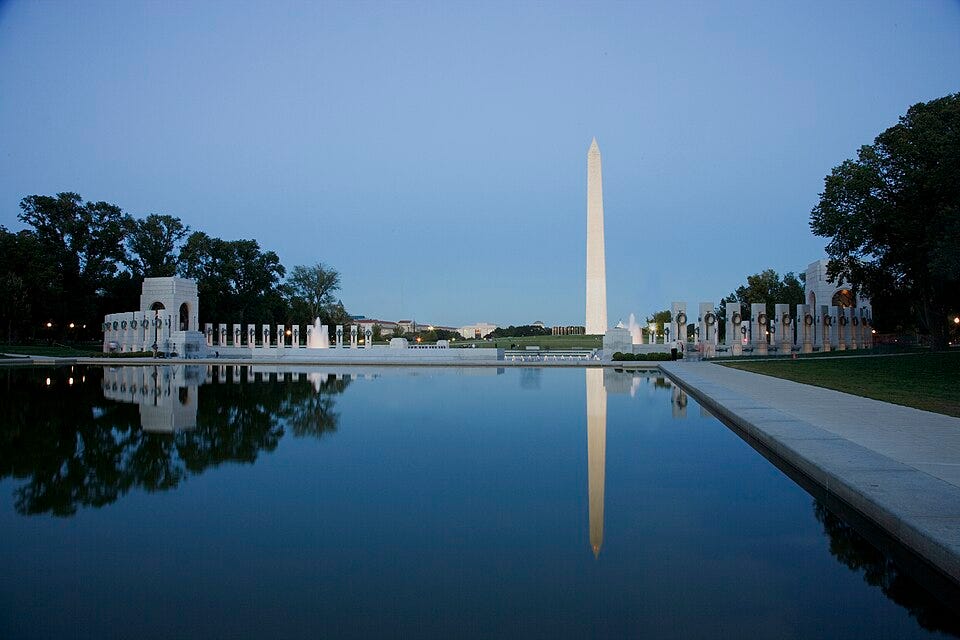
I want to tell you something about a pool. Not because a pool matters more than a war, or more than the price of groceries, or more than the sixteen American service members dead in a conflict their president started and keeps promising is almost over. It matters because it is the same story told in miniature — the same refusal to listen to people who know what they are talking about, the same no-bid contract to a loyalist with no relevant experience, the same ballooning cost that goes from the number said out loud to something eight times larger without anyone being held accountable, and the same escalating lie when the whole thing falls apart. A president who cannot be honest about a pool he broke will not be honest about a war he started. A government that invents vandals to explain away peeling paint will invent almost anything to explain away almost anything. That is why this story matters. Not because of the algae. Because of the pattern.
What follows is the full account — where this pool came from, what it took to finally fix it properly, what Trump did to it, what it cost, and what the growing lie about its destruction tells you about the man telling it. I have read the engineering documentation. I have read the contract records. I have read what the scientists said before the paint peeled, while it was peeling, and after. None of it is ambiguous. All of it is sourced. And none of it has been assembled in one place before this, which is why I am doing it here.
🟫
Before we get to the peeling paint and the growing slit and the Olympic canoeist who was indicted for touching a piece of loose coating that was already falling off on its own, it is worth understanding what the Lincoln Memorial Reflecting Pool actually is and where it actually sits, because without that context the story reads like a political embarrassment involving algae and a bad paint job, and it is considerably more than that. It is the story of a man who looked at one of the most carefully engineered public works in the history of the National Mall — a project that cost $34 million, took eighteen months, involved 2,133 timber piles driven to bedrock, a proprietary watertight concrete system, the Commission of Fine Arts, the National Capital Planning Commission, and multiple federal approval processes — and decided to fix it himself using a product designed for coating the inside of pipes, awarded on a no-bid contract to a company that had never held a federal contract before but had worked on his golf club swimming pools. The pool failed. The paint peeled. The algae bloomed. And rather than acknowledge any part of that, he told the country that vandals had cut a gash into the pool’s surface that has grown, in his own telling, from 300 feet to 350 feet to 900 feet, without a single photograph, a single arrest of an actual saboteur, or a single piece of evidence that any such gash exists at all.
The ground beneath the pool, and why it matters
The Lincoln Memorial Reflecting Pool sits on land that is, in the most literal geological sense, a swamp. The Army Corps of Engineers spent four decades, from 1870 onward, dredging 12 million cubic yards of mud from the Potomac River and depositing it where the Lincoln Memorial and its pool now stand. Speaker of the House Joseph Cannon called the site “that damned swamp” and fought against building there. He lost. The Lincoln Memorial was built anyway, and the engineers who built it understood exactly what they were dealing with: the memorial itself sits on 122 concrete pillars driven between 44 and 65 feet into the earth, reaching down through the dredged mud to find bedrock before they would commit the weight of the structure to it.
The pool, designed by architect Henry Bacon as a visual complement to his memorial, was built between 1920 and 1923 and was given no such consideration. Its bottom was laid in asphalt and tile directly on the soft dredged fill, with no pilings, no engineered foundation, no watertight system of any kind — nearly seven million gallons of water resting on what one historian has described as something with the consistency of wet sponge. It started leaking almost immediately after completion and never really stopped. By 1980 the unstable subgrade had deflected twelve inches under the weight of all that water. Engineers poured a new concrete slab over the original in 1980, which only added more weight to the same unstable ground and made the settlement worse. By 2010 the pool was leaking more than 500,000 gallons per week and consuming 30 million gallons of the city’s drinking water every year simply to maintain its water level.
Henry Bacon, who won the American Institute of Architects’ Gold Medal in 1923 — the ceremony held on the steps of his own memorial — died of intestinal cancer on February 16th, 1924, in a New York City hospital. His pool was less than a year old. He never saw it leak. He also never saw the 250,000 people who stood at its banks on August 28th, 1963, when the Reverend Martin Luther King Jr. delivered the speech that has made this particular body of water one of the most recognizable in the world. He never saw the 2,133 pilings that would eventually be driven through his pool’s floor to reach the bedrock his original design had never touched. He designed the pool to be a mirror, not a surface — a reflective plane meant to disappear under the sky, the monuments, and the trees, not to be looked at directly. The floor was never supposed to be seen. That design intention is important, and we will return to it.
How the pool was actually fixed, and what fixing it actually cost
The 2009-2012 rehabilitation of the Lincoln Memorial Reflecting Pool is the baseline against which everything that has happened in 2026 must be measured, because it represents the last serious, properly engineered attempt to solve the pool’s problems, and it is also the thing Trump’s renovation has now been layered over, incompatibly, at massive additional cost. The project was funded by the American Recovery and Reinvestment Act of 2009, managed by the Louis Berger Group, reviewed and approved by the Commission of Fine Arts and the National Capital Planning Commission, and built by Corman Construction using a watertight concrete system provided by Sika Corporation, whose proprietary “Whitebox” approach sealed every construction joint in the pool’s concrete shell using hydrophilic joint-sealing strips that expand on contact with water, creating a self-sealing barrier at the points where leaks most commonly originate. The 2,133 timber piles were driven to bedrock specifically to stop the ground settlement that had been causing the pool’s structural problems for ninety years. The water supply was converted from city drinking water — which the pool had been drawing at a rate of 30 million gallons per year — to a recirculating system drawing from the Tidal Basin, eliminating the stagnant water conditions that had been a primary driver of the pool’s historic algae problems. A dedicated ozone treatment system was installed specifically to manage algae chemically. The floor was resurfaced in neutral gray, specifically chosen to preserve the pool’s original reflective function — the mirror Bacon designed, the surface meant to disappear under the sky rather than call attention to itself. The whole project cost $34 million and took eighteen months.
Within weeks of the pool’s reopening in August 2012, there was an algae bloom. This is not the damning fact it might appear to be, because the National Park Service used the ozone system installed during the renovation to address it, spent $100,000 doing so, and the pool then operated without significant incident for fourteen years. Algae is not a solvable problem in a shallow, sunny, outdoor body of water in the mid-Atlantic summer. It is a manageable problem, and the 2012 renovation gave the Park Service the tools to manage it. That is what good engineering looks like in a situation where perfection is not available: it gives the people responsible for maintenance the infrastructure to keep doing their jobs. For fourteen years, they did.
What Trump actually did, and what it actually cost
In April 2026, Trump announced he was going to fix the Reflecting Pool’s algae problem by painting it. He said he had a guy — “a guy who’s unbelievable at doing swimming pools,” in his own words — and that the project would cost approximately $1.8 million. The guy was Atlantic Industrial Coatings, a Virginia-based company that had done pool work at a Trump golf club but had never, as of April 2026, held a single federal government contract in its existence. The National Park Service awarded it a no-bid contract on April 3rd, bypassing the competitive bidding process the law normally requires, using an emergency procurement justification tied to the desire to have the pool completed before Fourth of July celebrations. No review by federal historic preservation agencies. No opportunity for public comment. No congressional authorization. No consultation with the Commission of Fine Arts or the National Capital Planning Commission, both of which had reviewed the 2012 renovation. Just a phone call from the president, a pool guy from the golf club, and a no-bid contract.
Separately, the National Park Service awarded a second no-bid contract — also justified as an emergency, also bypassing competitive bidding — to Green Water Solutions, an Ohio-based company, to install a “nano bubble” filtration system. Green Water Solutions is owned by the JJ Cafaro Investment Trust. Its president and CEO, John J. Cafaro, is a neighbor of Trump’s at Mar-a-Lago and a donor who has given at least $250,000 to the Trump Victory fundraising committee, as well as extensive additional donations to Trump-linked causes and candidates. The nano-bubble contract came in at $1.74 million. Between the two companies, the project was originally presented to the public as costing roughly $1.8 million total.
It did not cost $1.8 million. By May 8th, federal contract data showed the Atlantic Industrial Coatings contract alone had grown to $13.1 million. By mid-June, additional payments had brought that figure to $14.65 million. By late June, with yet more payments recorded, it stood at $14.7 million. Add the Green Water Solutions contract, and the project’s total cost as of this writing exceeds $16 million — more than eight times the figure Trump publicly promised, and nearly half the cost of the 2012 renovation that actually solved the pool’s structural problems rather than painting over them. A government analysis obtained in the course of congressional oversight found that Atlantic Industrial Coatings’ proposal included a 20 percent profit margin. Senator Richard Blumenthal, ranking member of the Senate Permanent Subcommittee on Investigations, formally demanded documents from the company, asking specifically whether it had previously done work at Trump Organization properties and whether it planned to in the future. The House Appropriations Committee Democrats separately noted that Trump had “spent tens of millions of taxpayer funds on ballroom” projects and then lied about it.
Public Citizen filed Freedom of Information Act requests seeking the full communications and contract details. The Cultural Landscape Foundation filed a lawsuit. The questions about how these companies were selected, whether they had prior relationships with Trump, and how costs grew from $1.8 million to $16 million without triggering the normal contract modification review processes remain formally unanswered.
What the money actually purchased is also on the record. Scientific American identified the coating product used as Rhino Linings’ Pipeliner 5000 — a product designed, as its name indicates, for coating the inside of pipes, not for application to the surface of an outdoor pool. Experts interviewed by the New York Times said the resurfacing should have been done with a pure polyurea material rather than the hybrid material chosen, and that the chosen product was not as flexible as a pool application requires. The technical explanation for why the peeling was practically inevitable, identified by CRVS Science in a detailed engineering analysis, is even more specific and more damning: the Sika Whitebox concrete system installed during the 2012 renovation used hydrophobic, permeability-reducing admixtures chemically engineered into the concrete itself — concrete that was designed to repel liquids. Bonding a new liquid coating to a surface specifically designed to reject liquids requires aggressive mechanical surface preparation, including heavy abrasive shotblasting or diamond grinding, to remove the microscopic hydrophobic layer and open the concrete pores enough to create a molecular bond. If the surface preparation was inadequate, or if it was contaminated by mineral scale or biofilms, the coating would cure as a floating sheet that was never actually bonded to the concrete beneath it. That floating sheet is what peeled. Multiple engineers told various outlets that the curing time between applications was also likely insufficient, that summer heat and UV radiation accelerate adhesion failure in this class of product, and that applying it to the granite rim surfaces of the pool — where polyurea does not bond well regardless of conditions — made peeling virtually inevitable regardless of anything else. The firm that had done the original 2012 renovation was approached about this project and declined, according to CNN reporting, deeming the plan “unfeasible.” Trump drove to the pool on May 7th to inspect it at close range, with Interior Secretary Doug Burgum and Homeland Security Secretary Markwayne Mullin at his side. It began peeling within days of being refilled with water. By June 16th, National Park Service workers were pouring jugs of hydrogen peroxide into the water to combat the algae bloom that the Washington Post, using satellite imagery, confirmed was the largest recorded in the pool in the month of June for at least five years.
The color chosen made this outcome more likely, not less. The 2012 renovation’s architects chose neutral gray specifically because the pool is a mirror — a reflective surface whose function depends on the floor disappearing into the depth of the water rather than asserting itself visually. Trump’s “American Flag Blue” is a darker color than the previous surface. A darker bottom absorbs more heat from the sun. Warmer water directly and measurably accelerates algae growth. Dr. Peter May, an algae expert and ecologist at the University of Maryland, specifically identified three mistakes made by the administration during the overhaul: the color, the water, and the season in which the work was conducted. Matt Goodale, a water-treatment expert, told HuffPost that in changing the pool from a light to a dark color, “warmer water directly equals more algae growth” and that the administration was “fighting an uphill battle.” The algae bloom that followed was not a random natural event. It was the predictable consequence of choices that experts warned against before the work began, made by an administration that did not consult the experts whose job is to answer exactly these questions.
The lie that grows with each telling
On June 22nd, Trump told reporters that vandals had used a “box cutter or a knife” to cut a 300-foot slit in the pool’s newly coated surface and had poured fertilizer into the water to generate the algae bloom. He said the government had pictures and that they would be shown in court. No pictures have been produced publicly. Multiple scientists told PBS News that adding any small amount of fertilizer to a pool of this size — more than 300,000 square feet of water — would be “diffused into a massive body of water” and have essentially no measurable effect on algae levels. The idea that someone waded into the pool, cut a 300-foot slit in its surface, pulled the liner upward “with great force,” poured in fertilizer that somehow drove the largest June algae bloom in five years, and accomplished all of this in one of the most heavily trafficked tourist areas of Washington, D.C. without being photographed or immediately apprehended, was met by the scientific and engineering communities with essentially the same assessment: not credible.
The number has since grown. Trump’s initial 300-foot claim became a 350-foot gash in a Truth Social post days later. By July 13th, he had told the country the slash was 300 yards — 900 feet — nearly half the length of the entire 2,028-foot pool, and that the floor had been “cut and then pulled upward, with great force, by these thugs.” To summarize: vandals are now alleged to have cut a gash nearly half the length of the entire pool, pulled it up by hand with great force, in broad daylight, on the National Mall, without a single piece of photographic evidence, without any arrest of anyone actually responsible for the alleged sabotage, and with a growing dimension that has tripled between the first telling and the most recent one. What Trump has instead is six people detained, including David Hearn — a former United States Olympic canoeist who was arrested for touching a piece of loose coating that was already detaching from the pool’s surface on its own — and subsequently indicted by a grand jury on a federal charge that he had, in the words of U.S. Attorney Jeanine Pirro, “woefully destroyed property.” Hearn has pleaded not guilty.
What should actually be done
The answer to what should be done about the Lincoln Memorial Reflecting Pool is not a mystery, because the record of what has actually worked is sitting in the documentation of the 2012 renovation. The pool spent ninety years failing for identifiable, engineering-documented reasons: an unstable subgrade, a non-watertight basin, stagnant water with no recirculation, and no chemical treatment system capable of managing the algae that shallow, sunny, mid-Atlantic water will always produce in summer. The 2012 renovation addressed every one of those problems, correctly and expensively, and the pool functioned well for fourteen years as a result.
What the current situation requires is not another paint job. It is the removal of the incompatible polyurea coating that has already failed, the inspection and if necessary repair of the underlying Sika Whitebox concrete system that the 2012 renovation installed, the restoration of the neutral gray surface that allowed the pool’s reflective function to work as Bacon designed it, and the continued use of the ozone treatment system and recirculating water infrastructure already in place for managing algae — the system that worked for over a decade and cost $100,000 to operate when it was first needed in 2012, rather than $16 million to replace with a pipe lining product applied in the wrong season by a company that had never done federal work before but knew how to refinish a golf club pool. The firms that actually understand this infrastructure — including the one that declined this project as unfeasible — should be consulted through a proper competitive process with adequate time, appropriate seasonal conditions, and the federal oversight bodies that exist specifically to protect historic landmarks from exactly the kind of improvised renovation that has just been visited upon one of the most recognizable public spaces in America.
That is not a complicated prescription. It is the one the record already supports. The pool does not need an “American Flag Blue” paint job. It never did. It never will. What it needs is for the people responsible for it to read the engineering documentation from the last time it was properly fixed, and to do that again, correctly, with the right materials, the right contractor, and the right color — which is to say, no color at all.
🟫
I said at the start that a pool matters because of the pattern, not because of the algae. Here is the pattern, stated plainly, in case any part of the foregoing left it unclear.
A president looked at a carefully engineered public landmark that had taken ninety years and two serious renovations to finally get right, decided he knew better than the engineers, the historians, the preservationists, and the firm that did the actual work, awarded a no-bid contract to a company from his golf club that had never held a federal contract in its life, and a separate no-bid contract to a company owned by his Mar-a-Lago neighbor who had donated $250,000 to his campaign committee. He drove his motorcade across the freshly coated surface to admire it. He told the country it would cost $1.8 million. It has cost more than $16 million and is still not fixed. When the paint peeled and the algae bloomed, he did not say the product was wrong or the contractor was inadequate or that he had made a mistake. He invented vandals. He said they cut a slit into the pool’s surface. He said the slit was 300 feet long. Then 350 feet. Then 900 feet — nearly half the length of the entire pool, supposedly pulled upward by hand, in broad daylight, on the National Mall, with no photograph, no credible arrest, and no evidence of any kind. An Olympic athlete was indicted for touching a piece of loose coating that was already detaching on its own.
This is the same man telling you the Iran war is basically over. This is the same man who said it would take four to five weeks and is now in his nineteenth week. This is the same man whose own Defense Intelligence Agency told Congress in writing that Iran retains thousands of missiles and drones while his Defense Secretary was telling the country the Iranian navy had been wiped out. The pool and the war are not the same story in scale. They are the same story in character. A man who cannot tell the truth about a paint job that failed in a week will not tell the truth about a war. A man who invents a 900-foot slash in a pool he broke himself will invent whatever he needs to avoid saying that he was wrong. And a government that indicts an Olympic canoeist for touching peeling paint while the people who awarded a $16 million no-bid contract to a golf club pool company face no consequences at all has told you, in the clearest possible terms, whose side it is on.
The pool will be fixed eventually, by someone who reads the 2012 engineering documentation and does what it says. The war will end eventually, on terms no one has been told the truth about. In the meantime, the American people are paying for both, in money and in lives, and being told the whole time that everything is going beautifully.
It is not going beautifully. That is what this record is for.
— Fred Cochran, Author and Editorial Director War in Iran — The Trump-Netanyahu Wars
Sources
Pool history, original construction, and structural failures
Ghosts of DC, “Lincoln Memorial Reflecting Pool History: Bacon, McMillan,” May 10, 2026.
Wikipedia, “Lincoln Memorial Reflecting Pool,” accessed July 2026.
Grokipedia, “Lincoln Memorial Reflecting Pool,” accessed July 2026.
Factually.co, “What materials historically made up the Lincoln Memorial Reflecting Pool basin,” May 2026.
Water Shapes, “A Century of Reflections,” January 3, 2024.
Dave’s Locker, “Lincoln Memorial Reflecting Pool: History, Design, and Legacy,” May 17, 2026.
The 2010–2012 renovation — engineering specifications and cost
Sika Corporation, “Lincoln Memorial Reflecting Pool” project documentation, USA.sika.com, accessed July 2026.
Sika Corporation, “SIKA AT WORK — Lincoln Memorial Reflecting Pool, Washington D.C.,” technical case study PDF.
Sasaki Associates, “Lincoln Memorial Landscape and Reflecting Pool,” project documentation.
Saunders Construction / Corman Construction project records, cited in Sika documentation.
Wikipedia, “Lincoln Memorial Reflecting Pool,” 2012 renovation section, accessed July 2026.
Factually.co, “Who Paid for the Lincoln Memorial Reflecting Pool Renovations,” 2026.
Factually.co, “How Much Did the Lincoln Memorial Reflecting Pool Renovations Cost,” 2026.
The 2026 no-bid contracts, cost explosion, and contractor connections
The New York Times, “Trump Gave Out a No-Bid Contract to Turn D.C.’s Reflecting Pool Blue,” David Fahrenthold and Luke Broadwater, May 8, 2026.
The New York Times, “Reflecting Pool Repairs to Cost $13.1 Million. Trump Had Promised $1.8 Million,” David Fahrenthold and Luke Broadwater, May 11, 2026.
The New York Times, “Firm with Ties to Trump Donor Got No-Bid Contract to Clean Reflecting Pool,” June 18, 2026.
ABC News, “Reflecting Pool renovations to cost more than $16 million,” June 2026.
The Hill, “Lincoln Memorial Reflecting Pool contract hits $14.7M,” June 2026.
CBS News, “Company owned by Trump donor won $1.7 million no-bid Reflecting Pool cleaning contract,” June 18, 2026.
U.S. Senator Richard Blumenthal, letter to Atlantic Industrial Coatings LLC, June 24, 2026.
House Committee on Oversight and Accountability Democrats, letter to Atlantic Industrial Coatings LLC, June 24, 2026.
Public Citizen, “Let’s Get to the Bottom of Trump’s Expensive, No-Bid Contracts for the Lincoln Memorial Reflecting Pool,” FOIA filing, May 14, 2026.
Wikipedia, “Lincoln Memorial Reflecting Pool,” 2026 renovation section, accessed July 2026.
The peeling paint — technical analysis of why it failed
Scientific American, identification of Rhino Linings’ Pipeliner 5000 as the coating product used.
CRVS Science, “Green Water and Peeling Paint: The $14 Million Dollar Lincoln Memorial Reflecting Pool Disaster,” engineering analysis, June 2026.
Factually.co, “Is the Lincoln Memorial Reflecting Pool Basin Made of Concrete,” May 13, 2026.
CNN, exclusive: “Firm that worked on past Reflecting Pool renovation passed on Trump project after deeming it ‘unfeasible,’” Roedersheimer, Khurshudyan, and Serfaty, June 25, 2026.
Associated Press, “Trump drives across Lincoln Memorial Reflecting Pool to inspect blue coating he ordered,” May 8, 2026.
The algae bloom — scientific assessment
NPR, “Algae turns reflecting pool green after repainting. Here’s why,” Rachel Treisman, June 19, 2026.
HuffPost, “Trump’s Blue Reflecting Pool Paint Job May Have Worsened Algae Growth,” June 2026.
Al Jazeera, “Why Washington’s reflecting pool has gone from ‘US blue’ to algae green,” June 22, 2026.
The Washington Post, “Reflecting Pool algae bloom is one of biggest recorded in years after $14M renovation,” satellite data analysis, June 18, 2026.
MS Now, “How Trump’s reconstructed Reflecting Pool created a ‘perfect’ storm for algae,” Dr. Peter May, University of Maryland, June 28, 2026.
The vandalism claims and the growing slit
PBS News, “Was the Reflecting Pool vandalized? Experts cast doubt on Trump’s claims,” June 2026.
Roll Call / Factbase, Trump remarks, “300-foot slit” claim, June 22, 2026.
Truth Social, @realDonaldTrump, “350-foot gash” post, June 2026.
Truth Social, @realDonaldTrump, “300 yards” / 900-foot claim, July 13, 2026.
Truth Social, @realDonaldTrump, pool drained for repairs, July 14, 2026, via @atrupar on X.
Wikipedia, “Lincoln Memorial Reflecting Pool,” vandalism claims and arrests section, accessed July 2026.
Photo: Reflecting Pool on the National Mall with the Washington Monument reflected, Washington, D.C., by Carol M. Highsmith, Wikimedia